Jobs Europe
The Rising Impact of AI on Hiring Processes in European Companies
The Impact of AI on Recruitment in European Companies
Artificial intelligence is reshaping how employers across Europe attract, assess and hire talented professionals. From creating multilingual job advertisements to screening applications and coordinating interviews, AI-powered tools are increasingly influencing different stages of the recruitment process.
Companies ranging from international organisations to growing start-ups are adopting these technologies to improve efficiency, reach wider talent pools and manage recruitment workflows. At the same time, candidates expect hiring processes to remain accessible, transparent and fair.
As AI takes on a growing role in recruitment, employers must balance operational benefits with important legal and ethical responsibilities. Algorithmic bias, personal data protection, transparency and human oversight are becoming central considerations for organisations using automated hiring tools.
Jobs Europe supports employers navigating the changing European recruitment landscape. Through its recruitment platform, employers can access features such as unlimited job postings, ATS integrations, targeted campaigns, candidate management and employer branding opportunities. These capabilities help organisations manage recruitment activities across European markets and connect with professionals from different countries.
Whether you are an employer modernising your recruitment strategy, a recruiter managing international campaigns or a job seeker evaluating potential employers, understanding AI in recruitment is increasingly important. You can also browse jobs across Europe through Jobs Europe to explore career opportunities.
How AI Is Changing Recruitment in European Companies
AI in recruitment refers to digital systems that use algorithms, machine learning or other artificial intelligence techniques to support or influence hiring activities. These tools range from content-generation applications to advanced systems capable of analysing large volumes of candidate information.
Not every digital recruitment tool qualifies as artificial intelligence. For example, a basic calendar application that automatically schedules interviews does not necessarily use AI. The distinction depends on the technology, its functionality and how it is used.
What Is Considered AI in Recruitment?
Common examples of AI applications in recruitment include:
Candidate screening systems: Tools that analyse CVs, extract information and compare qualifications against job requirements.
Candidate matching algorithms: Systems that identify potential matches between candidate profiles and available vacancies.
Job advertisement generation: AI applications that help recruiters draft, improve or adapt job descriptions for different audiences.
Recruitment chatbots: Virtual assistants that answer candidate questions and provide application updates.
AI-supported assessments: Systems that analyse responses to tests or other assessments.
Interview assistance: Tools that transcribe conversations, organise interview information or support assessment workflows.
The level of risk depends on the purpose and influence of the system. An AI tool that helps draft a job description generally presents different risks from a system that ranks applicants or recommends who should be rejected.
Where AI Is Used in the Recruitment Process
Employers can use AI at several stages of recruitment:
Job advertising and candidate sourcing: Creating job descriptions, adapting advertisements and identifying potential candidates.
Application processing: Extracting information from CVs and organising applications.
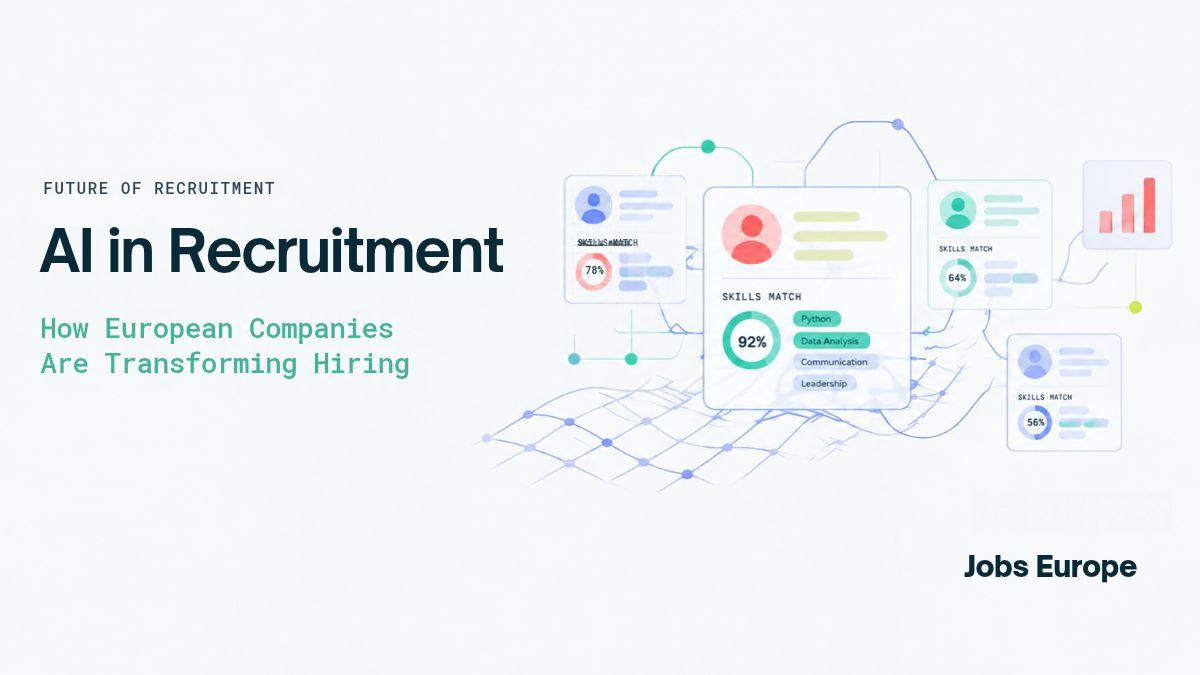
Candidate matching: Comparing professional experience, qualifications and skills against job requirements.
Assessments and interviews: Supporting digital assessments, transcription and the organisation of interview results.
Candidate communication: Providing application updates, answering frequently asked questions and sending reminders.
Recruiter administration: Supporting documentation, reporting and recruitment workflow management.
Some of these activities may involve high-risk AI systems under the EU AI Act, particularly when the technology is intended to influence recruitment or selection decisions. Others, such as basic scheduling and administrative support, may not fall into the same classification.
Common Applications of AI in Recruitment
AI-powered recruitment tools are becoming more sophisticated, allowing employers to automate repetitive tasks and manage larger candidate pools. The most common applications include the following.
Creating Job Advertisements and Sourcing Candidates
Generative AI tools can help recruiters draft job descriptions, improve wording and adapt advertisements for different languages or markets.
They can also support candidate sourcing by identifying profiles that appear relevant to particular vacancies.
For international employers, this can make it easier to communicate job opportunities across different European markets. However, automatically translating an advertisement is not the same as localising it. Recruiters should review terminology, qualifications and employment expectations to ensure that advertisements are appropriate for each target audience.
Employers can use Jobs Europe's recruitment platform to manage job distribution and reach candidates across European markets.
Parsing, Screening and Matching CVs
One of the most established applications of AI in recruitment is CV screening.
These systems can extract structured information from applications, identify relevant qualifications and compare candidate experience against predefined job criteria.
Potential benefits include:
Reducing repetitive manual screening.
Organising large volumes of applications.
Identifying relevant professional skills.
Supporting consistent application review.
Helping recruiters prioritise applications for further consideration.
However, automated rankings should not be treated as definitive measures of candidate suitability. A CV may contain relevant experience that an algorithm fails to recognise, particularly when candidates use different terminology or have qualifications from another country.
Recruiters should therefore retain meaningful human review when AI outputs influence important employment decisions.
Conducting Assessments and Supporting Interviews
AI can support digital assessments, interview administration and the processing of candidate responses.
Some systems transcribe interviews or organise information for recruiters. Others analyse assessment results against predefined criteria.
Employers should distinguish between tools that assist with administrative tasks and systems that evaluate candidates or influence selection decisions. The latter require much closer attention to accuracy, fairness, transparency and applicable legal obligations.
AI should support evidence-based recruitment rather than replace meaningful conversations with candidates.
Automating Scheduling and Candidate Communication
Recruitment teams frequently spend considerable time coordinating interviews, sending reminders and responding to routine questions.
Automation can help by:
Matching interview availability.
Sending appointment confirmations.
Providing application status updates.
Answering common candidate questions.
Organising follow-up communications.
These applications can improve the candidate experience when they provide timely and accurate information. Nevertheless, candidates should have a clear way to contact a human representative when their questions require individual attention.
Integrating AI with Applicant Tracking Systems
Applicant Tracking Systems (ATS) help employers organise vacancies, applications and recruitment workflows. Some platforms also incorporate AI-supported features for candidate matching, screening and communication.
Integrating recruitment tools with an ATS can reduce duplicated work and make information easier to manage. However, integration does not automatically guarantee data protection or legal compliance.
Employers remain responsible for understanding how candidate information is collected, transferred, stored and processed by their recruitment providers.
You can learn more about Jobs Europe's ATS integrations and how recruitment systems can support connected hiring workflows.
Benefits and Limitations of AI Hiring Tools
Companies adopt AI recruitment tools to improve efficiency, manage larger candidate pools and support more consistent workflows. However, these advantages should be considered alongside the limitations of automated systems.
Efficiency, Speed and Scalability
AI can process large volumes of information much faster than manual workflows. This can be particularly useful during large recruitment campaigns or when employers receive applications from several countries.
Potential advantages include:
Faster organisation and processing of applications.
Reduced administrative workload for recruitment teams.
More efficient communication with candidates.
Support for multilingual recruitment activities.
Improved management of recruitment campaigns.
More consistent handling of routine tasks.
For organisations recruiting internationally, these capabilities can help coordinate hiring activities across multiple markets.
Improving Candidate Experience and Recruiter Productivity
Automation can provide candidates with quicker acknowledgements, reminders and updates. This can reduce uncertainty during the application process.
It can also give recruiters more time to focus on activities that require human judgement, such as interviewing, evaluating professional experience and building relationships with potential employees.
Employers should nevertheless ensure that automated communication remains accurate, relevant and accessible. Candidates should not feel that they are interacting with an unresponsive system instead of a real recruitment team.
Why AI Efficiency Does Not Guarantee Better Hiring Outcomes
Faster recruitment does not necessarily mean better recruitment.
AI systems depend on their training data, design, configuration and suitability for the task they are expected to perform. If these factors are inadequate, automated tools may produce inaccurate or unfair results.
Potential limitations include:
Historical recruitment data may contain existing biases.
Algorithms may overlook qualified candidates with non-traditional career paths.
Different CV formats and language variations may affect screening accuracy.
Automated communication may feel impersonal.
Candidate rankings may not reflect professional potential or suitability.
Recruiters may become overly dependent on automated recommendations.
AI can improve parts of the recruitment process, but it cannot independently guarantee good hiring decisions, strong workplace relationships or a suitable cultural fit.
Employers can also use Jobs Europe's employer profiles to strengthen their visibility and communicate their organisation's identity to potential candidates.
Risks and Ethical Challenges of AI Recruitment
The use of AI in recruitment introduces responsibilities that employers must address before adopting automated hiring systems. Fairness, transparency, accessibility and data protection should be considered throughout the recruitment process.
Potential for Bias, Discrimination and Exclusion
AI systems can reproduce or amplify patterns present in the data used to develop or configure them.
For example, a screening tool trained on historical recruitment data may favour certain educational backgrounds, career paths or professional profiles. This can disadvantage candidates whose experience does not closely resemble previously successful applicants.
Other potential concerns include:
Unfair filtering based on location or educational background.
Disadvantages for candidates with career breaks.
Inadequate recognition of international qualifications.
Screening processes that disadvantage people with disabilities.
Language-related errors in multilingual applications.
Employers should regularly review screening criteria, test outcomes across different candidate groups and ensure that selection requirements are genuinely relevant to the position.
Privacy, Transparency and Candidate Trust
Recruitment systems process personal information, including CVs, contact details, employment history and professional qualifications.
Some tools may also process special-category personal data, which receives additional protection under the GDPR.
Employers should understand:
What candidate information is collected.
Why the information is being processed.
Which legal basis supports the processing.
How long information is retained.
Whether data is shared with external technology providers.
Whether AI is used to support or influence decisions.
Candidates should receive appropriate privacy information and be able to understand how their information is handled.
For more information, consult the European Commission's explanation of individual data protection rights.
Overreliance on Automated Scores and Decisions
AI-generated rankings can help recruiters organise applications, but they should not replace professional judgement.
A candidate who receives a low automated score may still have valuable experience, transferable skills or qualifications that the system does not recognise.
Recruiters should therefore:
Review the criteria used to assess candidates.
Check whether automated results are accurate.
Investigate unusual or unexpected outcomes.
Allow qualified professionals to challenge automated recommendations.
Provide meaningful human review where required.
Human oversight should involve genuine consideration and the authority to question or override an AI recommendation. Simply approving an automated result without examining it is not meaningful oversight.
Prohibited Emotion Recognition in Recruitment
The EU AI Act prohibits the use of AI systems designed to infer a person's emotions from biometric data in workplace settings, including recruitment and candidate selection, except for narrowly defined medical or safety purposes.
This is particularly relevant to tools that claim to assess candidates' emotional states through facial expressions, voice patterns or other biometric signals.
Employers should carefully examine recruitment assessment products and ask providers whether their systems include emotion recognition functionality.
The European Commission explains this restriction in its guidance on prohibited AI practices under the AI Act.
Practical Safeguards at Each Recruitment Stage
Responsible AI adoption requires different safeguards depending on how a tool is used.
1. Job Advertising and Candidate Sourcing
AI can help draft and optimise advertisements or identify potential candidates.
Practical safeguard: Review job advertisements for discriminatory language and ensure that targeting practices do not unfairly exclude particular groups.
2. Application Review and CV Screening
AI tools can extract information from CVs, compare qualifications and rank applicants.
Practical safeguard: Regularly review screening criteria and candidate samples to identify bias, inaccurate results or unjustified exclusions.
3. Candidate Assessments
AI-powered platforms can administer digital tests and automatically evaluate certain responses.
Practical safeguard: Ensure assessments are relevant to the job, accessible to candidates with disabilities and regularly tested for fairness.
4. Interviews and Candidate Evaluation
AI may support interview scheduling, transcription and assessment administration.
Practical safeguard: Avoid unsupported psychological or emotional inferences and ensure that consequential candidate evaluations receive appropriate human review.
5. Candidate Communication
Chatbots and automated systems can provide application updates, reminders and answers to common questions.
Practical safeguard: Make automated communication clear and provide candidates with a way to contact a human representative.
European Regulations: The EU AI Act and GDPR
AI recruitment in Europe is subject to several legal frameworks, particularly the EU Artificial Intelligence Act and the General Data Protection Regulation (GDPR).
These regulations address different aspects of AI use and personal data processing. Employers must understand how both apply to their recruitment activities.
AI Systems in Recruitment Classified as High-Risk
The EU AI Act identifies certain AI systems used in employment and recruitment as high-risk.
Under Annex III, this includes systems intended for recruitment or selection, particularly those used to:
Place targeted job advertisements.
Analyse and filter job applications.
Evaluate candidates.
Assist in making decisions affecting recruitment or selection.
This classification does not mean every AI tool used by an HR department is automatically high-risk. Basic administrative applications, such as ordinary interview scheduling tools, are not automatically included simply because they are used during recruitment.
The intended purpose and actual functionality of a system are important when determining its classification.
High-risk AI systems are subject to requirements that include:
Risk management and mitigation.
Appropriate data governance.
Technical documentation and record-keeping.
Human oversight.
Accuracy, robustness and cybersecurity.
Transparency and information requirements.
Employers using high-risk AI systems should understand their responsibilities as deployers, while also checking that providers meet the relevant requirements.
For further information, consult the European Commission's guidance on AI systems used in employment.
GDPR Requirements for Automated Recruitment Decisions
The GDPR applies to the processing of candidate personal data, whether recruitment activities are managed manually or supported by AI.
Employers need a valid legal basis for processing personal information and must follow principles such as purpose limitation, data minimisation, accuracy, storage limitation and security.
Article 22 of the GDPR also provides protection against decisions based solely on automated processing when those decisions produce legal effects or similarly significantly affect an individual.
This may be relevant to recruitment decisions such as automated rejection or selection where no meaningful human involvement takes place.
There are limited exceptions under Article 22, including certain situations involving contractual necessity, explicit consent or authorisation under applicable law. Where an exception applies, appropriate safeguards must be provided.
Depending on the circumstances, individuals may have rights to:
Obtain information about relevant data processing.
Access their personal data.
Request correction of inaccurate information.
Object to certain processing activities.
Request human intervention where Article 22 applies.
Express their point of view and contest qualifying automated decisions.
Employers should also assess whether a Data Protection Impact Assessment (DPIA) is required before introducing recruitment technologies that are likely to create high risks to individuals' rights and freedoms.
The official GDPR text and the European Commission's information on automated decision-making provide further guidance.
AI Recruitment Regulations and Compliance Deadlines in Europe
The EU AI Act entered into force on 1 August 2024 and applies progressively. Its implementation timeline was subsequently amended, so employers should use the current legal timetable rather than relying on older summaries.
Important milestones include:
1 August 2024: The EU AI Act entered into force.
2 February 2025: General provisions, including AI literacy requirements and certain prohibited AI practices, began applying.
2 August 2025: Rules concerning general-purpose AI models and certain governance obligations began applying.
2 August 2026: The majority of the AI Act's rules began applying, including relevant transparency provisions.
2 December 2027: Requirements for high-risk AI systems classified under Annex III, including relevant recruitment systems, are scheduled to apply.
2 August 2028: Requirements for high-risk AI systems covered by Annex I are scheduled to apply.
These dates concern the AI Act's application schedule. Other legal obligations, including GDPR requirements and applicable prohibitions, may already apply.
Although the AI Act establishes a common EU framework, national authorities are responsible for aspects of implementation, supervision and enforcement. The United Kingdom also has its own post-Brexit data protection and AI policy framework.
Employers recruiting across borders should therefore review the rules relevant to each country in which they operate.
For the latest official information, consult the EU AI Act implementation timeline and the consolidated EU AI Act on EUR-Lex.
This article provides general information and is not legal advice. Employers should obtain appropriate legal and data protection advice before implementing or expanding AI-driven recruitment processes.
How Employers Can Adopt AI Responsibly in Recruitment
Successful AI adoption requires more than choosing a technology provider. Employers need a clear strategy, appropriate safeguards and ongoing monitoring.
The following steps can help organisations introduce AI recruitment tools responsibly.
1. Define the Tool's Purpose and Role
Before implementing an AI solution, employers should establish exactly what the system is intended to do.
Important questions include:
Does it provide administrative support or evaluate candidates?
Does it rank or filter applications?
Can its outputs influence candidate progression or rejection?
Does it make recommendations or determine outcomes?
What information does it require to operate?
Understanding the tool's role helps employers assess its risks and determine which legal requirements apply.
2. Validate Accuracy, Fairness and Accessibility
AI recruitment tools should be tested before they are introduced into live hiring processes.
Employers should assess whether the system works reliably across different candidate profiles, languages and qualifications.
Testing should consider:
Potential discriminatory outcomes.
Recognition of international qualifications.
Different CV formats and writing styles.
Accessibility for candidates with disabilities.
Accuracy and consistency of assessment results.
Regular reviews are also important because system performance can change when software, data or recruitment requirements are updated.
3. Maintain Meaningful Human Oversight
Recruiters and hiring managers should retain appropriate responsibility for important employment decisions.
Human oversight should include the ability to question automated results, identify errors and override recommendations when necessary.
Employers should also train
Created 28 Nov 2026
Updated 28 Nov 2026